

Air Filtration in New Hampshire
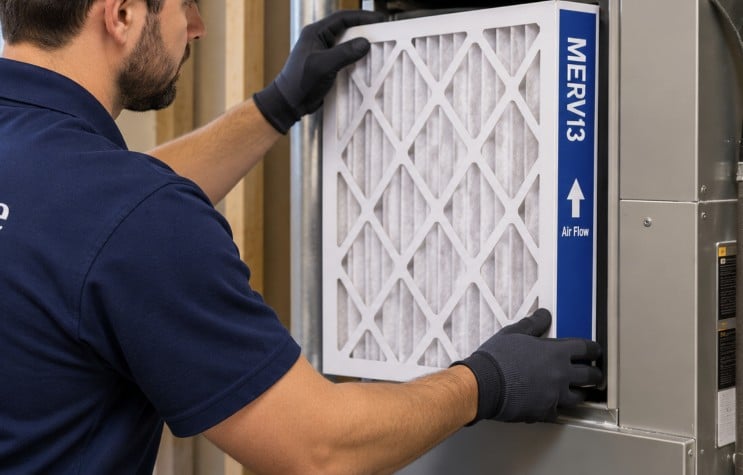
Dust, pollen, pet dander, and airborne particles can build up inside your home, especially during New Hampshire’s long heating season. Heritage Home Service provides professional whole-home air filtration in New Hampshire, helping homeowners improve indoor air quality with upgraded HVAC filters and media filtration systems. Our family-owned company evaluates your existing equipment, recommends compatible filtration options, and helps your household enjoy cleaner air without compromising heating and cooling performance.
Key Takeaways
- Whole-home air filtration captures dust, pollen, pet dander, and certain smoke particles as air circulates through an HVAC system.
- Upgraded filters and media filter cabinets can improve particle capture compared with basic filters.
- MERV ratings help homeowners compare how effectively filters capture airborne particles.
- Proper filter sizing and airflow compatibility protect heating and cooling performance.
- New Hampshire’s closed-window winters and pollen-heavy springs make effective filtration especially useful.
- Regular filter replacement supports cleaner indoor air and helps protect HVAC equipment.
What Is Whole-Home Air Filtration?
Whole-home air filtration captures airborne particles as air passes through your home’s forced-air heating and cooling system.
Unlike portable air cleaners designed for individual rooms, whole-home filters work with compatible ductwork to filter air circulating throughout the house.
A filtration system typically includes an upgraded HVAC filter or a dedicated media filter cabinet installed in the return-air pathway.
Depending on filter efficiency, these systems can capture:
- Household dust and lint
- Tree and grass pollen
- Pet dander and some airborne pet hair
- Certain mold spores
- Some fine smoke particles
- Other airborne debris
Filtration effectiveness depends on the filter material, system airflow, operating time, and particle size.
Homes without central ductwork may need alternative solutions, such as portable air cleaners or compatible filtration equipment.
Why Is Air Filtration Important for New Hampshire Homes?
New Hampshire’s seasonal weather creates indoor air quality challenges that can make filtration particularly valuable.
Long Winters With Closed Windows
During freezing weather, homeowners in Manchester, Concord, Nashua, and surrounding communities often keep windows closed for months.
Indoor dust, pet dander, and other particles can accumulate when ventilation is limited.
Whole-home filtration helps capture particles circulating through the HVAC system, although it doesn’t replace proper ventilation.
Spring Pollen and Seasonal Allergies
Spring brings pollen from trees, grasses, and other vegetation throughout New Hampshire.
Pollen enters homes through doors, windows, clothing, and pets.
Higher-efficiency filters can capture airborne pollen before it continues circulating through the house.
Smoke and Outdoor Air Pollution
Wood-burning appliances, wildfire smoke, and outdoor pollution can introduce fine particles into indoor air.
Appropriately rated filters may capture some smoke particles, helping reduce airborne concentrations.
However, standard particle filters do not remove all gases or odors associated with smoke.
What Types of Whole-Home Air Filters Are Available?
Different filtration systems provide different levels of particle capture.
Upgraded HVAC Filters
Standard disposable filters primarily protect HVAC equipment from larger dust particles.
Higher-efficiency replacement filters capture additional airborne particles, including smaller allergens.
However, installing a dense filter without checking airflow requirements can reduce system performance.
Media Filter Cabinets
Media filter cabinets hold deeper filters within compatible HVAC ductwork.
These filters often provide more surface area than standard one-inch filters, allowing improved particle capture with manageable airflow resistance when properly designed.
Media filters may also last longer between replacements, depending on their size, construction, and household conditions.
Heritage helps homeowners compare filtration options based on their existing equipment and indoor air quality concerns.
Concerned about dust or allergens? Contact Heritage Home Service to schedule a whole-home air filtration assessment in New Hampshire.
What Do MERV Ratings Mean?
MERV stands for Minimum Efficiency Reporting Value. It measures how effectively an air filter captures particles of different sizes under standardized testing conditions.
Higher MERV ratings generally indicate better particle capture.
Common categories include:
- MERV 1–4: Basic filtration for larger particles such as lint and coarse dust.
- MERV 5–8: Improved capture of dust, pollen, and some mold spores.
- MERV 9–12: Greater filtration of smaller particles, including some pet-related allergens.
- MERV 13–16: Higher-efficiency filtration capable of capturing more fine particles, including certain smoke particles.
A MERV 13 filter may be helpful for households concerned about fine airborne particles.
However, the best filter is one your HVAC equipment can support without excessive airflow restriction.
How Does Heritage Match Filtration to Your HVAC System?
Choosing a whole-home filter requires more than selecting the highest available MERV rating.
Heritage technicians evaluate the furnace or air handler to determine which filtration options are compatible.
The assessment may include:
- Equipment inspection: Identify the furnace, air handler, and existing filter configuration.
- Filter sizing: Check dimensions and available installation space.
- Airflow evaluation: Determine whether upgraded filtration could restrict airflow.
- Household concerns: Discuss allergies, pets, dust, and other particle sources.
- System recommendations: Compare compatible replacement filters and media cabinets.
- Maintenance guidance: Explain filter inspection and replacement requirements.
Proper airflow is especially important during New Hampshire winters when furnaces may operate for extended periods.
An overly restrictive filter can increase equipment strain, reduce heating performance, and contribute to unnecessary energy use.
How Often Should Whole-Home Air Filters Be Changed?
Filter replacement depends on equipment type, household conditions, and manufacturer instructions.
General guidelines include:
- Standard one-inch filters: Inspect monthly and replace approximately every one to three months.
- Deeper media filters: Some models last six to twelve months before replacement.
- Homes with pets: Inspect filters more frequently because fur and dander can increase particle accumulation.
- Allergy-sensitive households: Check filters regularly during spring pollen season.
- Heavy HVAC usage: Increase inspection frequency during extended heating or cooling periods.
These intervals are general recommendations rather than fixed requirements.
Heritage can recommend a replacement schedule suited to your equipment and household.
Can Air Filtration Help With Allergies and Household Dust?
Effective filtration can reduce airborne allergens such as pollen, dust, and pet dander.
For allergy-sensitive households, reducing exposure to these particles may improve indoor comfort.
However, filtration cannot eliminate every allergen or replace medical treatment.
Capturing airborne dust may also reduce the amount that settles on furniture, shelves, and floors.
This can make routine cleaning easier, although vacuuming and surface cleaning remain necessary.
Clean filters also protect HVAC components from excessive dust accumulation.
By maintaining airflow and limiting debris buildup, proper filtration can support equipment efficiency and help reduce avoidable wear.
Why Choose Heritage Home Service for Air Filtration?
Heritage has served New England homeowners for decades, providing heating, cooling, plumbing, electrical, and indoor air quality services.
Our experienced HVAC technicians help homeowners select filtration equipment that addresses their concerns while maintaining proper system operation.
Homeowners benefit from:
- Professional indoor air quality assessments
- Compatible HVAC filter recommendations
- Whole-home filtration options
- Airflow and equipment evaluations
- Upfront estimates and clear explanations
- Ongoing heating and cooling maintenance
We serve homeowners throughout New Hampshire, including Manchester, Nashua, Concord, Bedford, Portsmouth, Laconia, and surrounding communities.
For additional solutions, visit our Indoor Air Quality Services in New Hampshire page.
Frequently Asked Questions About Air Filtration in New Hampshire
-
What’s the difference between air filtration and air purification?
Air filtration physically captures particles as air passes through a filter. Air purification is a broader category that may include mechanical filtration, activated carbon, ultraviolet treatment, and other technologies targeting different contaminants.
-
Are air cleaners different from whole-home filters?
Air cleaners include portable devices and systems connected to HVAC equipment. Some use mechanical filters, while others use additional technologies. Whole-home filters specifically capture particles circulating through compatible ductwork.
-
Is a MERV 13 filter suitable for every furnace?
No. Some systems cannot accommodate the additional airflow resistance of higher-efficiency filters. A technician should evaluate equipment compatibility before upgrading.
-
Can whole-home filtration remove smoke odors?
Particle filters can capture some smoke particles but generally cannot remove smoke-related gases and odors. Specialized activated carbon equipment may help address certain gaseous contaminants.
-
Will whole-home filtration reduce cleaning time?
It may. Capturing airborne dust before it settles can reduce some household dust accumulation. Regular vacuuming and surface cleaning are still important.
-
Does air filtration work when the HVAC system is off?
Most duct-mounted filtration systems capture particles only when air moves through the filter. Some systems can circulate air independently through a compatible fan setting.
Schedule Whole-Home Air Filtration in New Hampshire
Cleaner indoor air begins with properly selected filtration equipment and consistent maintenance.
Heritage Home Service helps New Hampshire homeowners evaluate HVAC filters, compare whole-home filtration upgrades, and maintain proper system airflow.
Call Heritage Home Service today to schedule an air filtration consultation in New Hampshire and request an estimate for a solution that fits your home and heating and cooling equipment.


Financing Made Easy
When you choose Heritage, you can rest easy knowing that we provide straightforward options to help you budget for a complete solution that will last you for decades to come.
VIEW FINANCING OPTIONS

Home Advantage Membership
With Home Advantage Membership, enjoy peace of mind knowing your home’s plumbing, heating, cooling, and electrical needs are handled year after year—hassle-free, with added benefits.
VIEW MEMBERSHIP
What Our Customers Are Saying
Warren was extremely knowledgeable and familiar with my home and what’s going on with it. There was no pressure, and he even gave us a few tips to help save a bit of money! As a new homeowner, this was wonderful! Will definitely be booking service in the near future!
Show More
Marae Perruzzi
I ask Heritage Home Service for a Licensed plumber to come to my home to fill out Water Flow Form for Water Efficiency. Gladly the plumber came and checked everything and filled out the form without charging me. It’s a great company to start with. They are understanding what the customer is looking for. Thank you Heritage.
Show More
gmej
Michael arrived promptly on appointment time. Was very respectful and communicative on my first annual service on my new boiler system. A+++
Show More
BeachBoi08
The heritage team, Cory, and Edgar, We’re very professional, courteous and conscious not to interrupt anything in a person‘s home. I was very impressed with their knowledge and their assessment of what was going on. Excellent.
Show More
Jewel Church
Jim was very courteous and helpful. Unfortunately he was unable to fix the problem that I was having but he did the best he could and it was not his fault that he couldn’t fix the problem. I was not charged for the service which I am very much appreciated
Show More
Mary Fuller
We had a plumbing leak in our half bath in the basement. I looked online for a plumber near me and heritage home service was the first to come up. It said it was family owned and had been in business for 30 years so I felt that was a good advertising point. I called them. They told me that someone would be by that afternoon And they gave me a 4-Hour window. A young man named Ben called and said he was running ahead of schedule and would we mind if he stopped by early. Early? A rarity. So he stopped by. Took a look at our situation. Gave us a quote and got to work. He was done within 40 minutes, he kept the area clean and the commotion minimal. He was very personable and very professional. I highly recommend.
Show More
Marcia Fanning
Jim was great. Immediately pinpointed the issue, and just like that… fixed. Very grateful he fixed, definitely will use their service again
Show More
Viviann C
Fast clean and professional couldn’t ask for anything more very polite took the time to answer all my questions and point things out to me so much so that I signed up for the yearly service
Show More
Bob Mele
Todd did excellent work and was both friendly and informative. Once again, excellent work and service from Heritage. Thank you!
Show More
Carol D.
Eric was a pleasure to have as a service tech work our furnace today in Alton. He was promt, proficient and professional in every aspect. He gave a detailed explanation for everything he did in cleaning and evaluating our furnace on School St..
Show More
Ronald Breth
Schedule a comprehensive service near you!
Whether you need routine maintenance, repair, or new installation – we have you covered.