
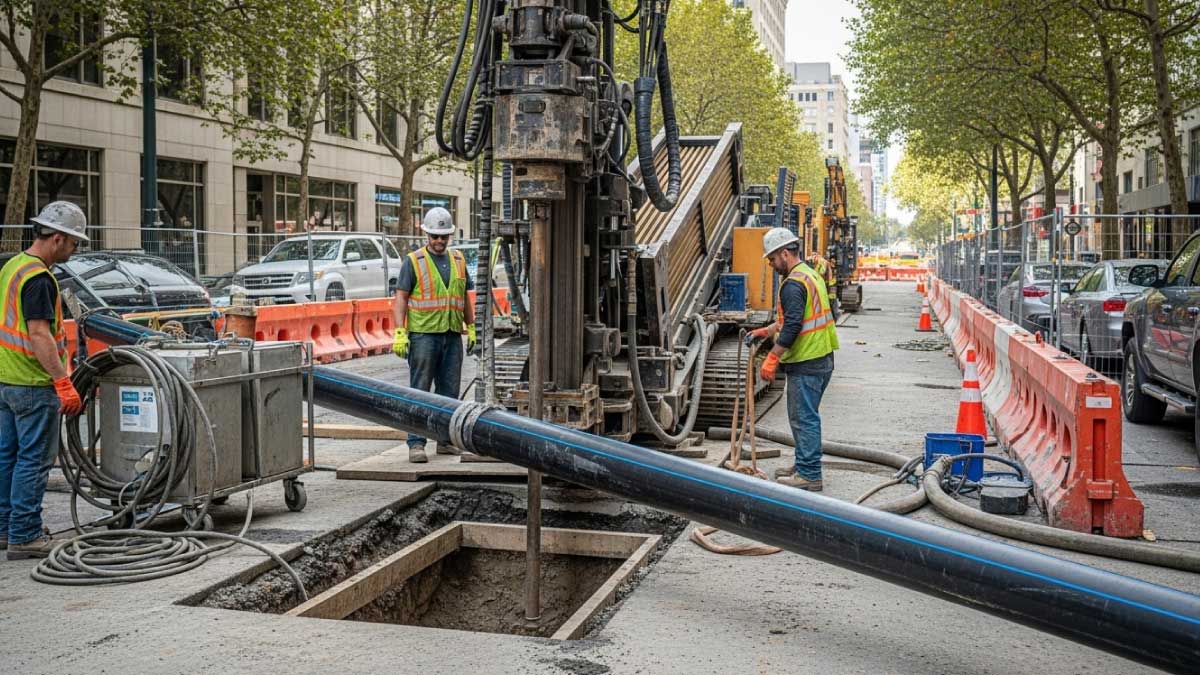
Trenchless Sewer Repair in New Hampshire: No-Dig Pipe Solutions
Heritage Home Service is proud to offer trenchless sewer repair solutions to homeowners across New Hampshire. If you have been told your sewer line needs repair or replacement and you are dreading the thought of a torn-up yard, a destroyed driveway, or weeks of disruption — trenchless technology may be exactly what you are looking for.
Trenchless sewer repair allows our licensed plumbers to restore or replace a damaged sewer line with little to no digging. In most cases, we need only one or two small access points to complete a full repair. Your lawn, landscaping, and hardscaping stay intact, and the job is typically done in a single day.
What Is Trenchless Sewer Repair?
Trenchless sewer repair is a category of pipe repair and replacement methods that work from the inside of the existing pipe rather than requiring full excavation along the length of the line. Instead of digging a trench from your foundation to the street, technicians access the pipe from one or two small entry points and use specialized equipment to either line the inside of the damaged pipe or pull a new pipe through the old one.
The result is a fully restored sewer line — with a new interior surface or an entirely new pipe — without the landscape destruction that traditional excavation requires. Trenchless methods have been in use for decades and are now the preferred approach for most residential sewer line repairs and replacements in New Hampshire when the pipe condition allows for it.
The Two Main Trenchless Methods Heritage Uses
Pipe Lining: Cured-In-Place Pipe (CIPP)
Pipe lining, also known as cured-in-place pipe or CIPP, involves inserting a flexible liner coated with epoxy resin into the damaged pipe. The liner is inflated against the walls of the existing pipe and the resin is then cured — either with heat, UV light, or ambient temperature depending on the system — forming a hard, smooth new pipe within the old one.
The finished liner bonds to the interior of the host pipe and seals cracks, root intrusion points, and deteriorated joints. The new surface is smooth, which actually improves flow capacity compared to older corroded or root-damaged pipe. Pipe lining is an excellent solution when the existing pipe is structurally compromised but still largely in place.
Pipe lining works well for:
• Pipes with cracks or fractures that have not fully collapsed
• Root intrusion through joints or small breaks
• Corroded or deteriorating cast iron or clay pipe still holding its shape
• Pipes with leaking joints that are causing ground infiltration
Pipe Bursting: Full Pipe Replacement Without a Trench
Pipe bursting is used when the existing pipe needs to be fully replaced rather than lined. A bursting head is pulled through the old pipe via a cable, fracturing the existing pipe outward into the surrounding soil as it moves. Simultaneously, a new pipe — typically high-density polyethylene, or HDPE — is pulled into position behind the bursting head, taking the place of the old pipe.
Pipe bursting is a true replacement method. The old pipe is destroyed and displaced, and a brand-new pipe of equal or greater diameter takes its place. This method is particularly effective for pipes that are too deteriorated for lining and for situations where upgrading the pipe diameter is desirable.
Pipe bursting works well for:
• Severely deteriorated pipe that cannot support a liner
• Older clay or cast iron lines that need full replacement
• Situations where increasing the pipe diameter is beneficial
• Lines with significant root damage throughout their length
Is My Sewer Line a Candidate for Trenchless Repair?
Not every sewer line is a candidate for trenchless methods. The condition of the existing pipe, its depth, its diameter, and the layout of the line all factor into whether trenchless repair is feasible. A sewer camera inspection is always the first step — it is the only way to accurately assess what is happening inside the pipe and determine which approach is appropriate.
Trenchless repair is generally a good fit when:
• The pipe is damaged but still largely intact in its position underground
• The pipe has a consistent diameter and accessible entry points
• There are no severe offsets or complete collapses along the line
• The surrounding soil is stable enough to support the bursting process
Traditional excavation may be the better choice when:
• The pipe has collapsed or shifted significantly out of alignment
• Multiple access points would be needed due to the line’s layout
• The pipe is at a very shallow depth that limits trenchless equipment use
• Other underground issues need to be addressed at the same time
Heritage will always be straightforward with you about which method is right for your specific situation. If traditional excavation is the more appropriate approach, we will tell you why and make sure you understand the full picture before any work begins.
The Trenchless Repair Process: What to Expect
Knowing what happens on the day of a trenchless repair helps set realistic expectations. Here is how the process typically unfolds:
1. Pre-repair camera inspection. Before any work begins, we run a sewer camera through the line to map the damage, measure pipe diameter, and confirm the line is suitable for the chosen trenchless method.
2. Access point preparation. For most residential jobs, we excavate one small pit at the entry point of the line — typically near the foundation — and one at the exit point near the street connection or clean-out. These pits are much smaller than a traditional excavation trench.
3. Pipe cleaning. Before lining or bursting, the existing pipe is cleaned thoroughly, usually with hydro jetting, to remove debris, roots, and buildup. A clean pipe surface is essential for proper liner adhesion in CIPP work.
4. Liner installation or pipe bursting. For CIPP, the resin-saturated liner is inserted and inflated. Curing time varies by system but is typically a few hours. For pipe bursting, the bursting head and new pipe are pulled through in a single pass.
5. Post-repair camera inspection. Once the work is complete, we run the camera again to verify the liner has cured correctly or the new pipe is properly seated, and to confirm there are no remaining issues.
6. Access point restoration. The small excavation pits are backfilled and compacted. Because no trench runs the length of the line, surface restoration is minimal.
Trenchless vs. Traditional Sewer Repair: A Side-by-Side Comparison
Homeowners weighing their options often want a direct comparison. Here is how the two approaches stack up across the factors that matter most:
Disruption to property: Trenchless requires only small access pits. Traditional excavation requires a trench the full length of the sewer line, which typically means significant disruption to grass, landscaping, driveways, or walkways.
Project timeline: Trenchless repairs are typically completed in one day for standard residential lines. Traditional excavation projects often take two to four days or longer, plus additional time for surface restoration.
Total cost: The pipe work itself for trenchless methods may cost somewhat more per linear foot than open-cut pipe. However, when you factor in the cost of landscape restoration, driveway repair, and the general disruption of traditional excavation, trenchless methods often come out ahead on total project cost — sometimes significantly so.
Longevity: Both methods, when properly executed, produce a sewer line that will last for decades. HDPE pipe used in pipe bursting and quality CIPP liners are both rated for 50 years or more under normal conditions.
Why Trenchless Repair Is Especially Valuable in New Hampshire
New Hampshire homeowners often have mature landscaping, established trees, paved driveways, and hardscaping that took years to develop. The idea of tearing any of that up for a sewer repair is understandably upsetting — and with trenchless technology, it usually does not have to happen.
New Hampshire’s freeze-thaw cycles also mean that any ground that is excavated and backfilled in traditional repair will go through multiple freezing seasons before it fully settles. Trenchless methods sidestep this concern entirely by leaving the surrounding soil undisturbed.
Frequently Asked Questions About Trenchless Sewer Repair in NH
How long does a trenchless sewer repair last?
CIPP liners and HDPE pipe used in pipe bursting are both designed to last 50 years or more when properly installed. Heritage uses quality materials and follows best practices to ensure the repair holds for the long term.
Will trenchless repair work if my pipe has tree roots in it?
Yes, in most cases. Hydro jetting prior to lining removes root material from the pipe, and the cured liner seals off the entry points where roots were infiltrating. Pipe bursting destroys the old pipe — roots and all — entirely.
Does trenchless sewer repair require a permit in New Hampshire?
In most municipalities, yes. Sewer line repair and replacement typically require a permit regardless of the method used. Heritage handles the permitting process as part of every project.
Call Heritage Home Service today to schedule your sewer camera inspection and find out if trenchless repair is right for your New Hampshire home. Same-day service available — our licensed plumbers are ready to help.
For generations, families across New England have counted on Heritage Home Service for trustworthy, expert care. Call today to schedule your appointment and experience the difference of service built on integrity and tradition.
Are You Ready for Year Round Comfort?
We approach your installation with a single goal in mind – to earn your loyalty for the long term. This is not a transaction to complete but a relationship to build.
Schedule a comprehensive service near you!
Whether you need routine maintenance, repair, or new installation – we have you covered.