
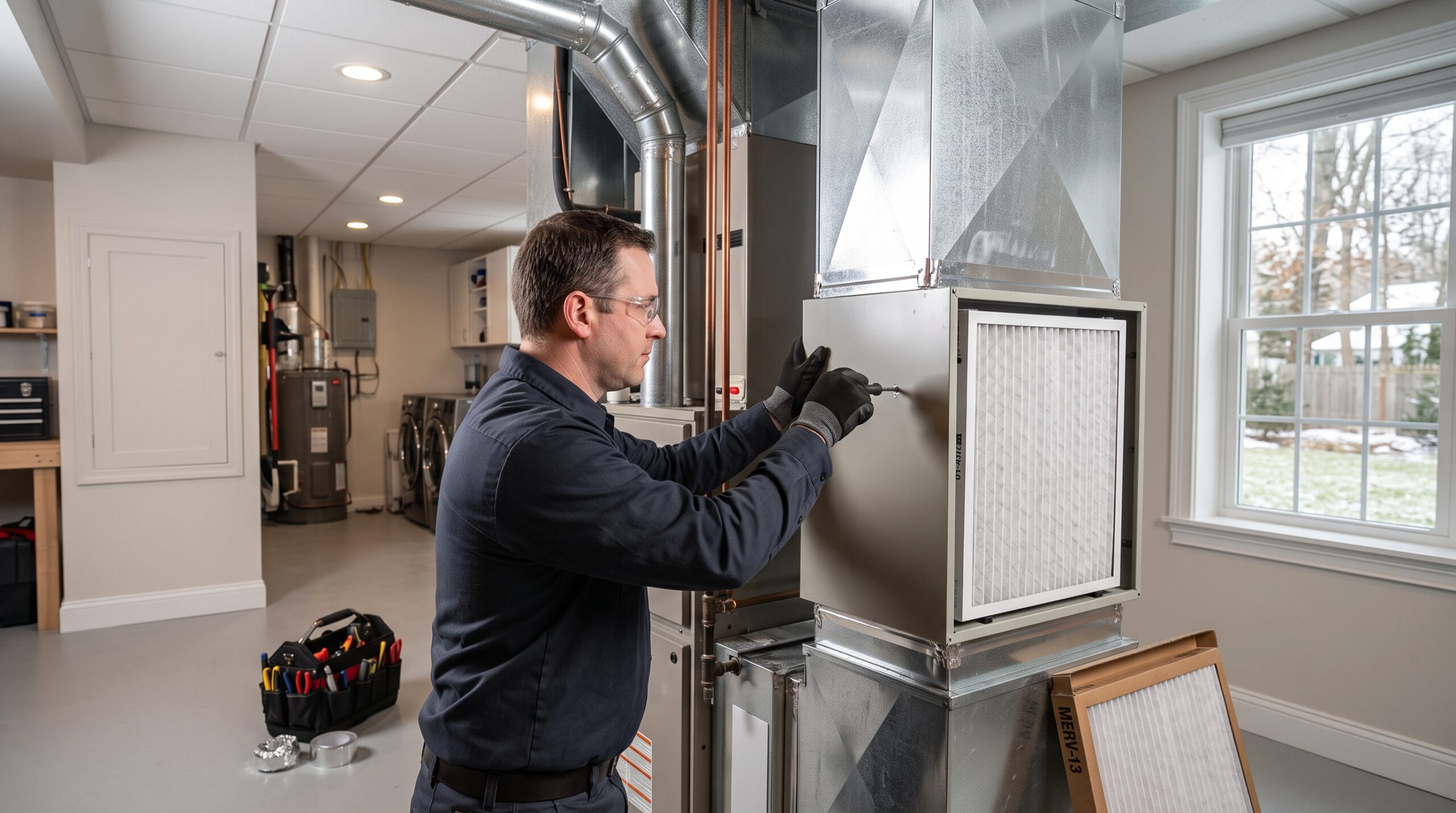
Air Filtration in Massachusetts
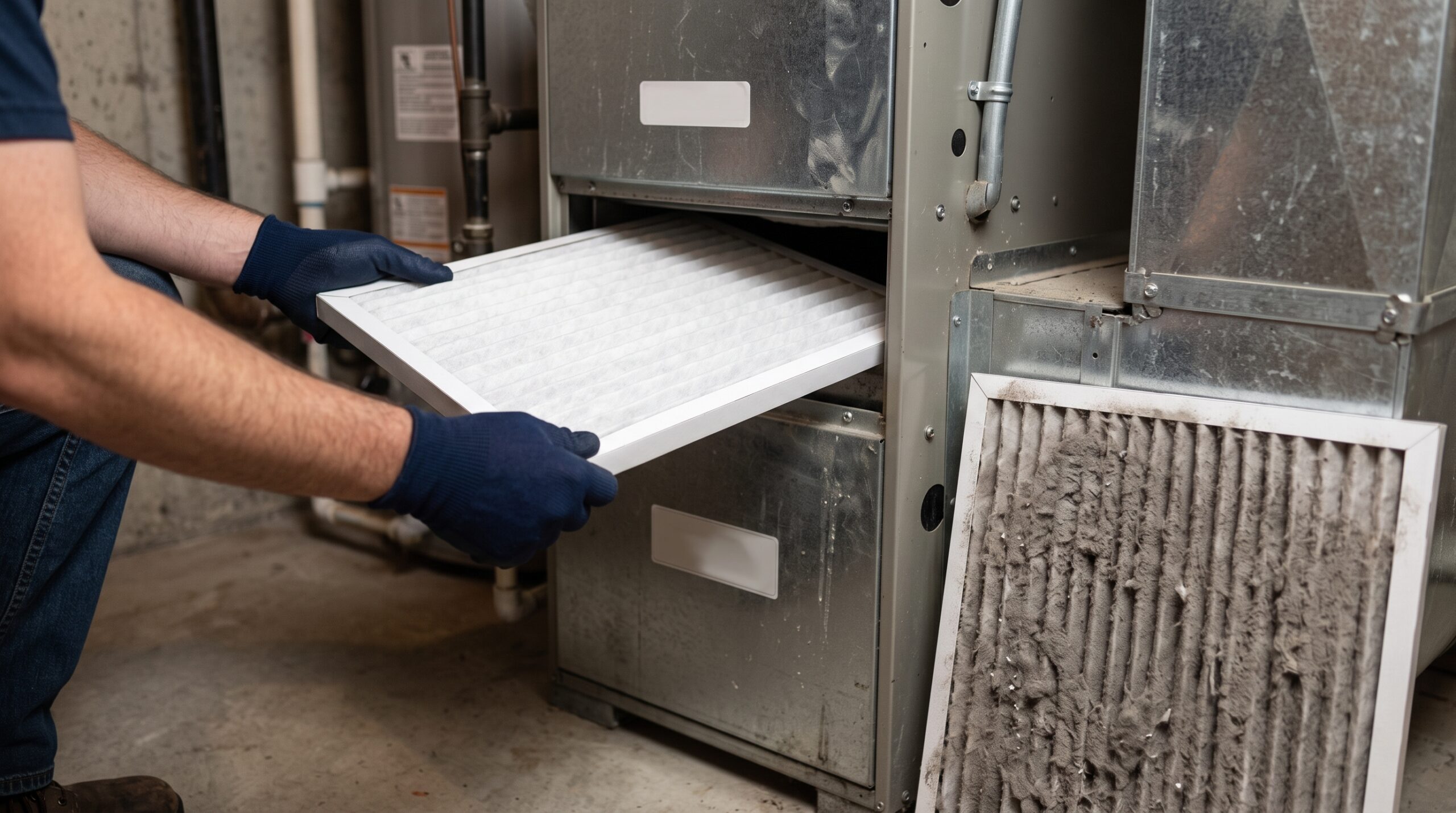
Heritage Home Service is proud to help Massachusetts homeowners choose and maintain the right air filter for their HVAC system. Filtration is one of the simplest, most affordable ways to improve the air moving through your home — but only if you’re using the right filter, in the right place, replaced on the right schedule.
Air Filtration vs. Air Cleaners vs. Air Purification: What’s the Difference?
These related terms often get lumped together, but they describe different approaches to improving your home’s air:
- Air filtration is what this page covers: the filter media inside your existing HVAC system, its MERV rating, and how often it needs to be replaced.
- Air cleaners are dedicated hardware — electronic or high-capacity media units installed directly into your ductwork — designed for a much higher particle capture rate than a standard filter. Visit our Air Cleaners page for that equipment.
- Air purification refers to active treatment technologies, such as UV light or ionization, aimed at neutralizing germs, mold spores, and odors rather than capturing particles. Visit our Air Purification page if that’s your primary concern.
If you’re not sure which category actually addresses what’s happening in your home, an indoor air quality test can help. Visit our IAQ Testing page to learn more about that process.
What Homeowners Need to Know About MERV Ratings
MERV stands for Minimum Efficiency Reporting Value, and it’s the standard used to measure how effectively a filter captures airborne particles. Ratings generally range from 1 to 20, and understanding where your filter falls matters for both air quality and system performance:
- MERV 1–4: Basic fiberglass filters that mainly protect your HVAC equipment from large debris, with minimal impact on air quality
- MERV 5–8: Common pleated filters that capture household dust, pollen, and mold spores
- MERV 9–12: Higher-efficiency filters that capture finer particles, including some pet dander and smaller allergens
- MERV 13–16: Filters capable of capturing bacteria, smoke particles, and very fine dust, often recommended for allergy-sensitive households
- MERV 17–20: HEPA-level filtration, typically reserved for specialized or medical-grade applications rather than standard residential systems
Higher isn’t always better for every home. A filter rated too high for your specific HVAC system can restrict airflow, forcing your equipment to work harder and potentially reducing its lifespan.
Choosing the Right Filter for Your HVAC System
The right filtration choice depends on more than just the highest available MERV rating. Our technicians consider:
- Your HVAC system’s airflow capacity, since not every furnace or air handler is designed to pull air through a dense, high-MERV filter
- Household needs, including allergies, pets, or respiratory sensitivities
- Filter size and fit, ensuring a proper seal so air isn’t bypassing the filter around the edges
- Replacement frequency, which varies significantly depending on filter type, household size, and pets
Common Filtration Problems We See in Massachusetts Homes
Improper filtration is one of the most common — and most overlooked — issues affecting both air quality and HVAC performance:
- Filters left in far too long, restricting airflow and straining the system
- A MERV rating too high for the system, reducing airflow and efficiency
- A MERV rating too low for household needs, allowing allergens and fine dust to circulate
- Improperly sized or poorly sealed filters, letting unfiltered air bypass the filter entirely
- Inconsistent replacement schedules, especially in households that don’t realize how quickly filters can become clogged
How to Know When You Need a Filtration Assessment
Consider having your filtration reviewed if:
- You’re unsure what MERV rating your current filter is, or whether it’s the right fit for your system
- Your energy bills have increased and airflow feels weaker than it used to
- You’re noticing more dust or allergy symptoms than expected
- You’ve recently added pets to the household and haven’t adjusted your filtration accordingly
- Your HVAC system seems to be working harder than it should during normal operation
A Homeowner Scenario: The Wrong Filter in Laconia
A homeowner in Laconia had upgraded to the highest MERV-rated filter available at their local hardware store, hoping to improve their family’s allergy symptoms. Instead, their furnace began short-cycling and airflow throughout the home noticeably weakened. During a service visit, our technician explained that the filter’s density was restricting airflow beyond what their system was designed to handle. Switching to a MERV rating matched to their specific furnace resolved the short-cycling while still meaningfully improving air quality.
Filter Types and Typical Replacement Schedules
| Filter Type | Typical MERV Range | General Replacement Schedule |
| Basic fiberglass | 1–4 | Every 30 days |
| Standard pleated | 5–8 | Every 60–90 days |
| High-efficiency pleated | 9–12 | Every 60–90 days |
| Allergy-grade pleated | 13–16 | Every 90 days, sooner with pets |
Actual replacement timing depends on household size, pets, and local air quality, so these ranges are a general starting point rather than a fixed rule.
Air Filtration in MA
FAQs
-
What MERV rating is best for my home?
It depends on your specific HVAC system’s airflow capacity and your household’s needs. A technician can confirm the highest MERV rating your system can handle without restricting performance.
-
Can a filter rated too high actually damage my HVAC system?
Yes. A filter too dense for your system’s airflow capacity can force the blower motor to work harder, potentially shortening its lifespan and reducing efficiency.
-
How often should I really be changing my filter?
This varies by filter type and household, but many homes benefit from checking filters monthly and replacing them every 60 to 90 days, or sooner with pets or allergy concerns.
-
Is a higher MERV rating the same as an air cleaner or purifier?
No. A high-MERV filter still relies on your system’s standard filtration slot, while air cleaners and purifiers are separate, dedicated equipment. See our Air Cleaners and Air Purification pages for those options.
Schedule Your Air Cleaner Installation Today
For generations, families across New England have counted on Heritage Home Service for trustworthy, expert care. If dust, dander, or allergens are affecting your home’s air, call Heritage Home Service today to find out if a whole-home air cleaner is the right fit.


Financing Made Easy
When you choose Heritage, you can rest easy knowing that we provide straightforward options to help you budget for a complete solution that will last you for decades to come.
VIEW FINANCING OPTIONS

Home Advantage Membership
With Home Advantage Membership, enjoy peace of mind knowing your home’s plumbing, heating, cooling, and electrical needs are handled year after year—hassle-free, with added benefits.
VIEW MEMBERSHIP
What Our Customers Are Saying
Warren was extremely knowledgeable and familiar with my home and what’s going on with it. There was no pressure, and he even gave us a few tips to help save a bit of money! As a new homeowner, this was wonderful! Will definitely be booking service in the near future!
Show More
Marae Perruzzi
I ask Heritage Home Service for a Licensed plumber to come to my home to fill out Water Flow Form for Water Efficiency. Gladly the plumber came and checked everything and filled out the form without charging me. It’s a great company to start with. They are understanding what the customer is looking for. Thank you Heritage.
Show More
gmej
Michael arrived promptly on appointment time. Was very respectful and communicative on my first annual service on my new boiler system. A+++
Show More
BeachBoi08
The heritage team, Cory, and Edgar, We’re very professional, courteous and conscious not to interrupt anything in a person‘s home. I was very impressed with their knowledge and their assessment of what was going on. Excellent.
Show More
Jewel Church
Jim was very courteous and helpful. Unfortunately he was unable to fix the problem that I was having but he did the best he could and it was not his fault that he couldn’t fix the problem. I was not charged for the service which I am very much appreciated
Show More
Mary Fuller
We had a plumbing leak in our half bath in the basement. I looked online for a plumber near me and heritage home service was the first to come up. It said it was family owned and had been in business for 30 years so I felt that was a good advertising point. I called them. They told me that someone would be by that afternoon And they gave me a 4-Hour window. A young man named Ben called and said he was running ahead of schedule and would we mind if he stopped by early. Early? A rarity. So he stopped by. Took a look at our situation. Gave us a quote and got to work. He was done within 40 minutes, he kept the area clean and the commotion minimal. He was very personable and very professional. I highly recommend.
Show More
Marcia Fanning
Jim was great. Immediately pinpointed the issue, and just like that… fixed. Very grateful he fixed, definitely will use their service again
Show More
Viviann C
Fast clean and professional couldn’t ask for anything more very polite took the time to answer all my questions and point things out to me so much so that I signed up for the yearly service
Show More
Bob Mele
Todd did excellent work and was both friendly and informative. Once again, excellent work and service from Heritage. Thank you!
Show More
Carol D.
Eric was a pleasure to have as a service tech work our furnace today in Alton. He was promt, proficient and professional in every aspect. He gave a detailed explanation for everything he did in cleaning and evaluating our furnace on School St..
Show More
Ronald Breth
Schedule a comprehensive service near you!
Whether you need routine maintenance, repair, or new installation – we have you covered.